Prism Refactory.
Infrastructure for Collaborative AI Communities.
Prism Refactory helps communities turn chat, meetings, docs, and repos into shared context. Start with Discord. Build toward durable community memory, knowledge, and operator workflows without giving up control over infrastructure or data.
Built on the Prism Stack. Open source. Self-hostable. Discord-first.

AI tools are built for individuals.
But the most complex work happens in communities:
- • Discord-native communities
- • open source communities
- • research collectives
- • contributor networks and DAOs
- • distributed teams and agencies
These teams struggle to maintain shared context across conversations, meetings, documents, repositories, and AI agents.
Prism Stack gives communities a practical way to capture, organize, and use that context with AI in the loop.
Core Capabilities
What the stack does
Prism Stack is designed to make community context usable, durable, and actionable.
● Live Surface
Discord Ingestion
Bring live community activity into a usable context layer instead of leaving it trapped in channels and threads.
● Live Surface
PrismBOT in Discord
Give communities a live bot and agent interface inside Discord for summaries, retrieval, meeting flows, and operator-style interactions.
● Live Surface
Meeting Capture
Turn voice meetings into transcripts, summaries, and durable artifacts that can be referenced later.
● Live Surface
Shared Memory
Maintain rolling community memory instead of relying on scattered chat history and operator recollection.
● Live Surface
Knowledge Sync
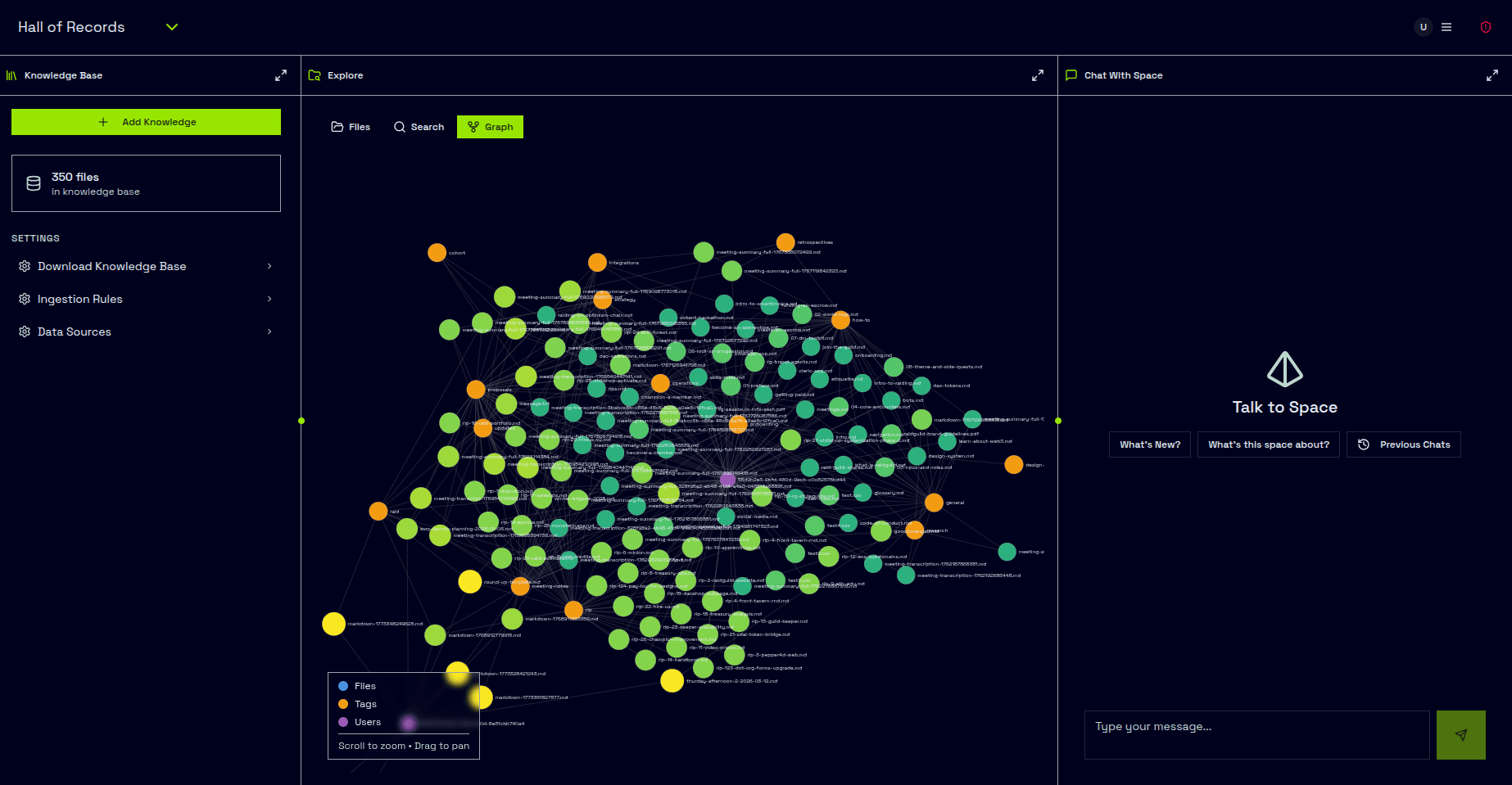
Sync docs and repos into a searchable knowledge surface that agents and contributors can use.
● Live Surface
Operator and Admin Workflows
Run config, memory operations, runtime actions, and change-request workflows inside the same system instead of across disconnected tools.
Stack Components
Each service has a clear role
Prism Stack is designed as a set of focused services rather than one opaque AI app. That makes it easier to operate, adapt, and extend.
Community Interface
discord-adapter
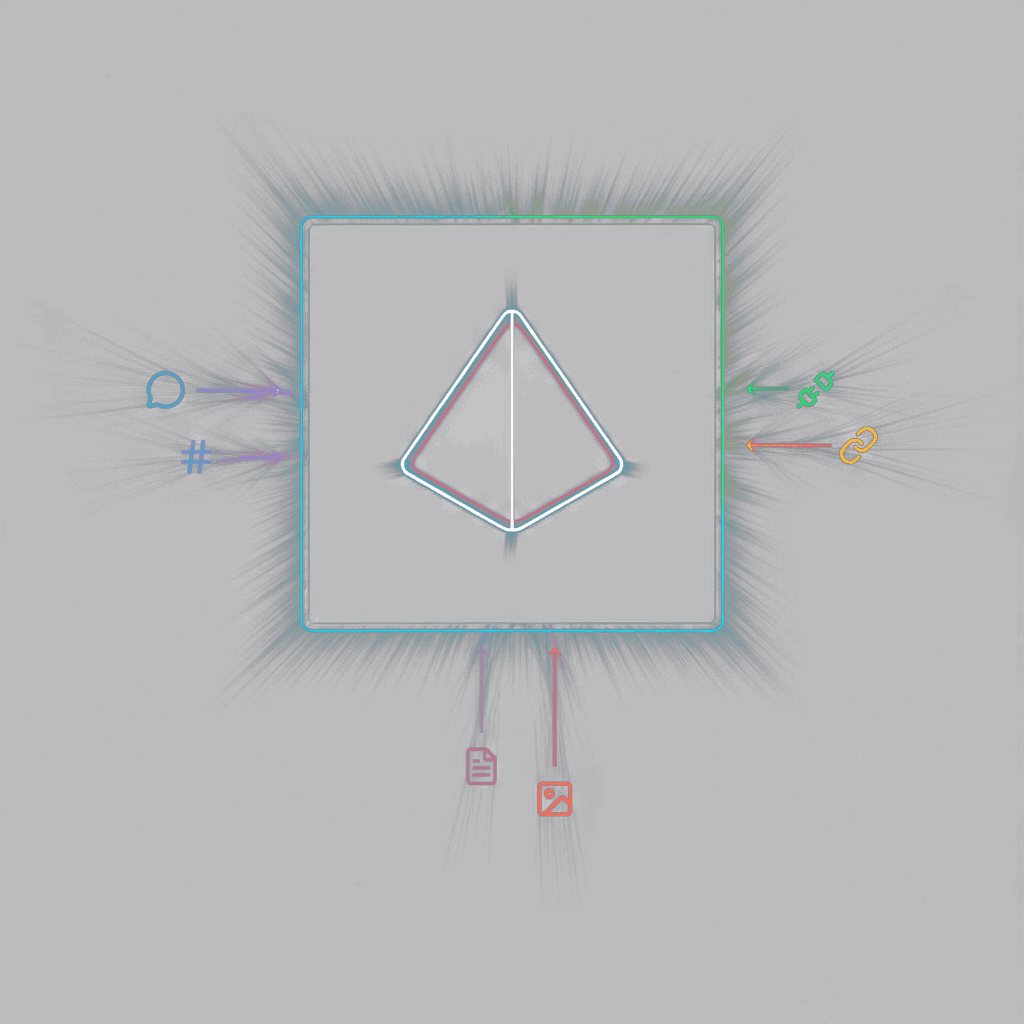
Connects the stack to Discord. It handles live bot interaction, chat and meeting ingestion, and voice-based artifact capture so community activity can feed the rest of the system.
- •PrismBOT in Discord
- •chat and thread ingestion
- •voice meeting capture and artifacts
Agent Runtime
codex-runtime
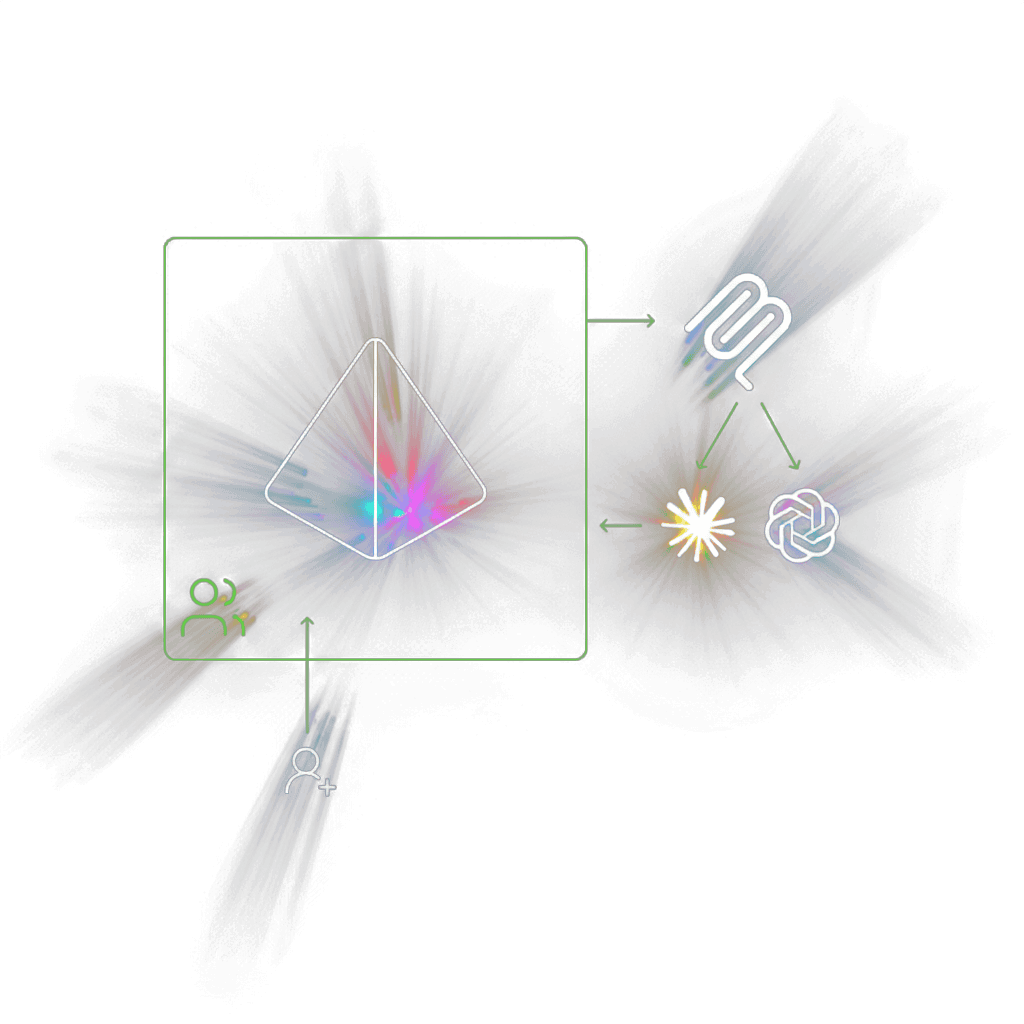
Runs Codex-backed agent workflows behind a service boundary. It gives the stack a reusable execution layer for operator chat, change-request workflows, and other future transports.
- •shared runtime endpoint
- •persistent auth and workspace state
- •agent execution for admin and bot flows
Memory + Knowledge
prism-memory
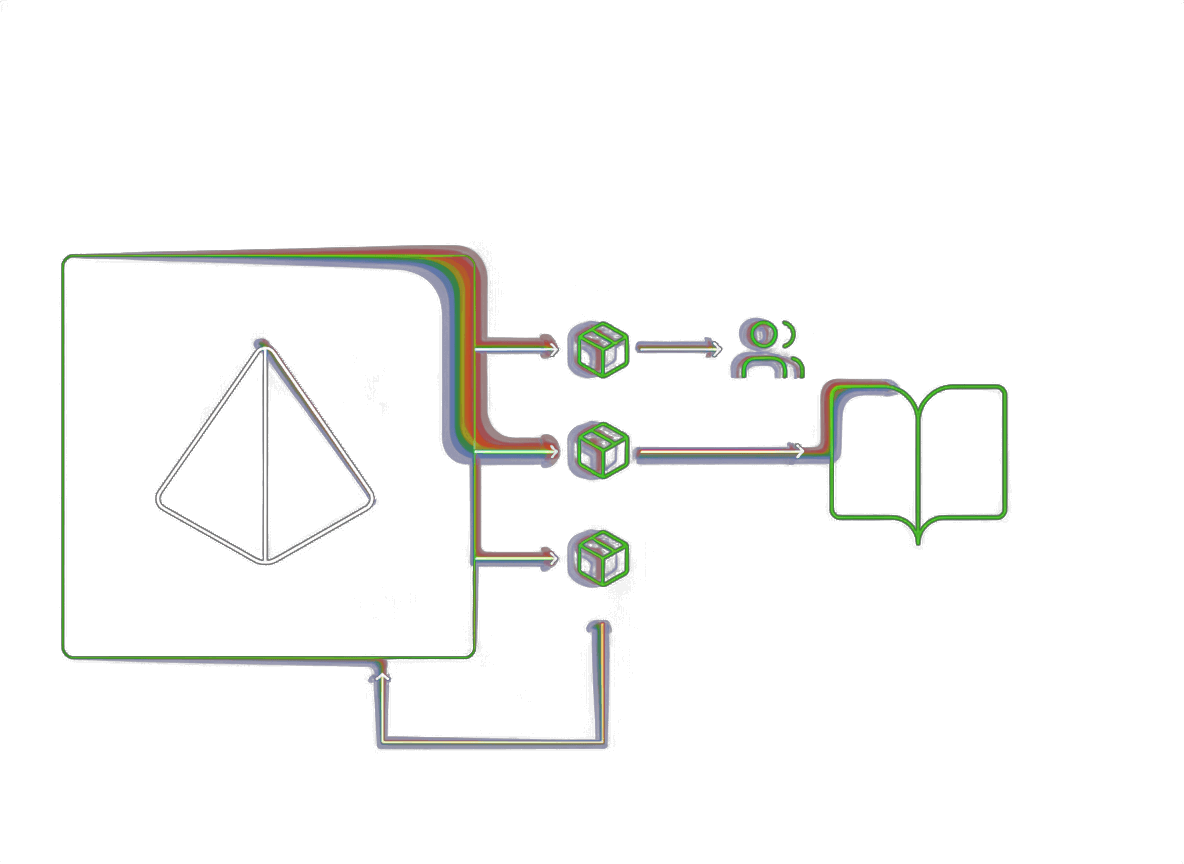
Owns normalized ingest, rolling memory, knowledge retrieval, and ops pipelines. This is the context layer that turns community activity into reusable artifacts and searchable knowledge.
- •memory inbox and rolling context
- •knowledge sync and retrieval
- •ops runs for memory and knowledge
Operator Surface
site
Provides the web app, admin workspace, and app API. This is where operators review requests, manage settings, inspect workflows, and interact with the stack as a system.
- •admin workspace
- •change request workflow
- •settings, memory access, and app state
System View
From community activity to usable context
Prism Stack is not just a chat interface. It is a coordination system that captures community activity and turns it into memory, knowledge, and operator-facing workflows.
The goal is to help communities preserve continuity, reduce repeated synthesis work, and make AI operate on shared context instead of isolated prompts.
Reference Flows
- •Discord conversation -> memory artifact -> searchable context
- •Voice meeting -> transcript + summary -> linked artifacts
- •Knowledge source sync -> docs and repo content become queryable
- •Operator prompt -> runtime action -> updated workflow state
- •Config through chat -> space policy and memory behavior can evolve in place
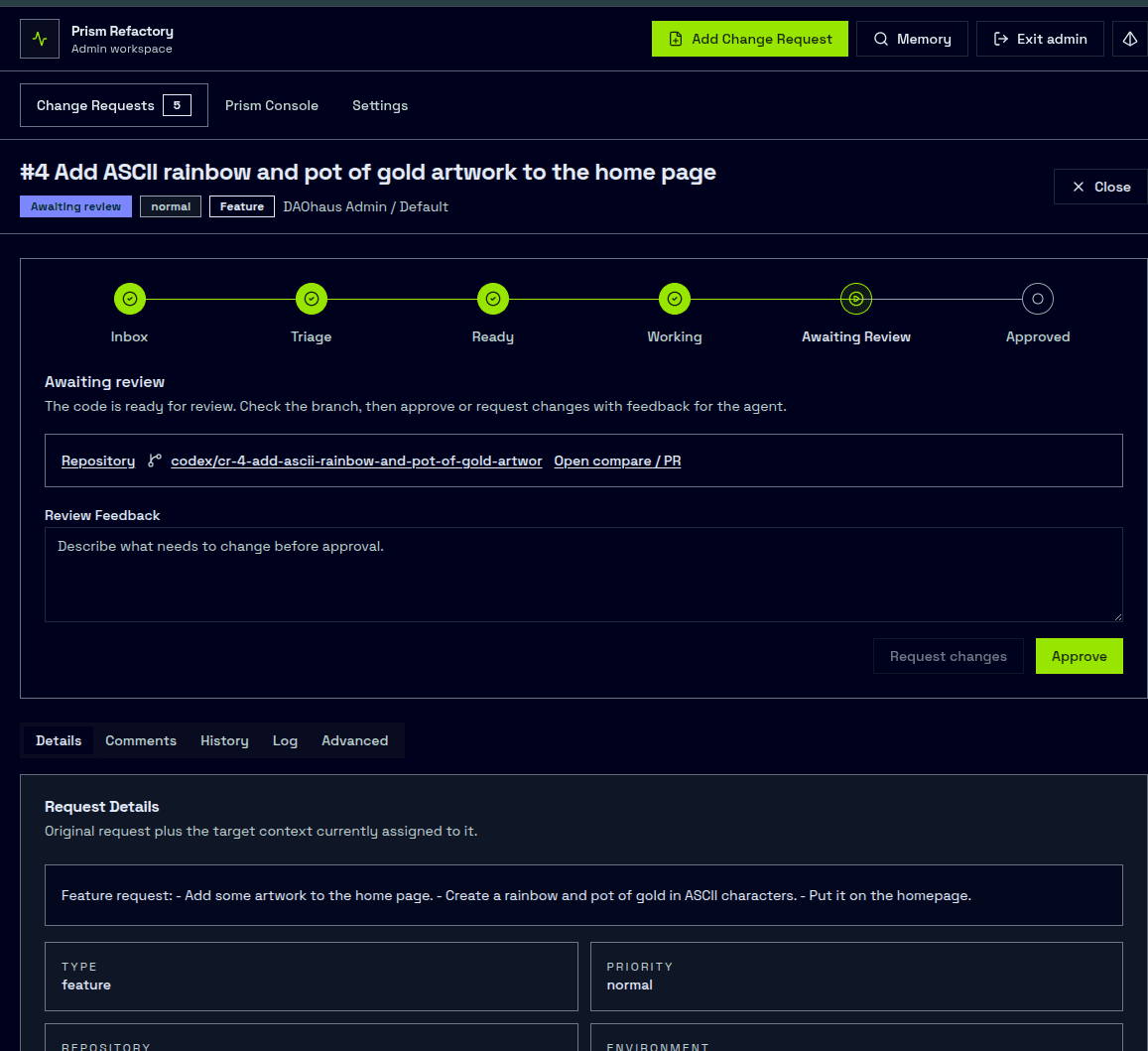
Review and Approval
Operator work is surfaced as explicit request state, review steps, and branch-aware execution instead of disappearing into ad hoc chat.
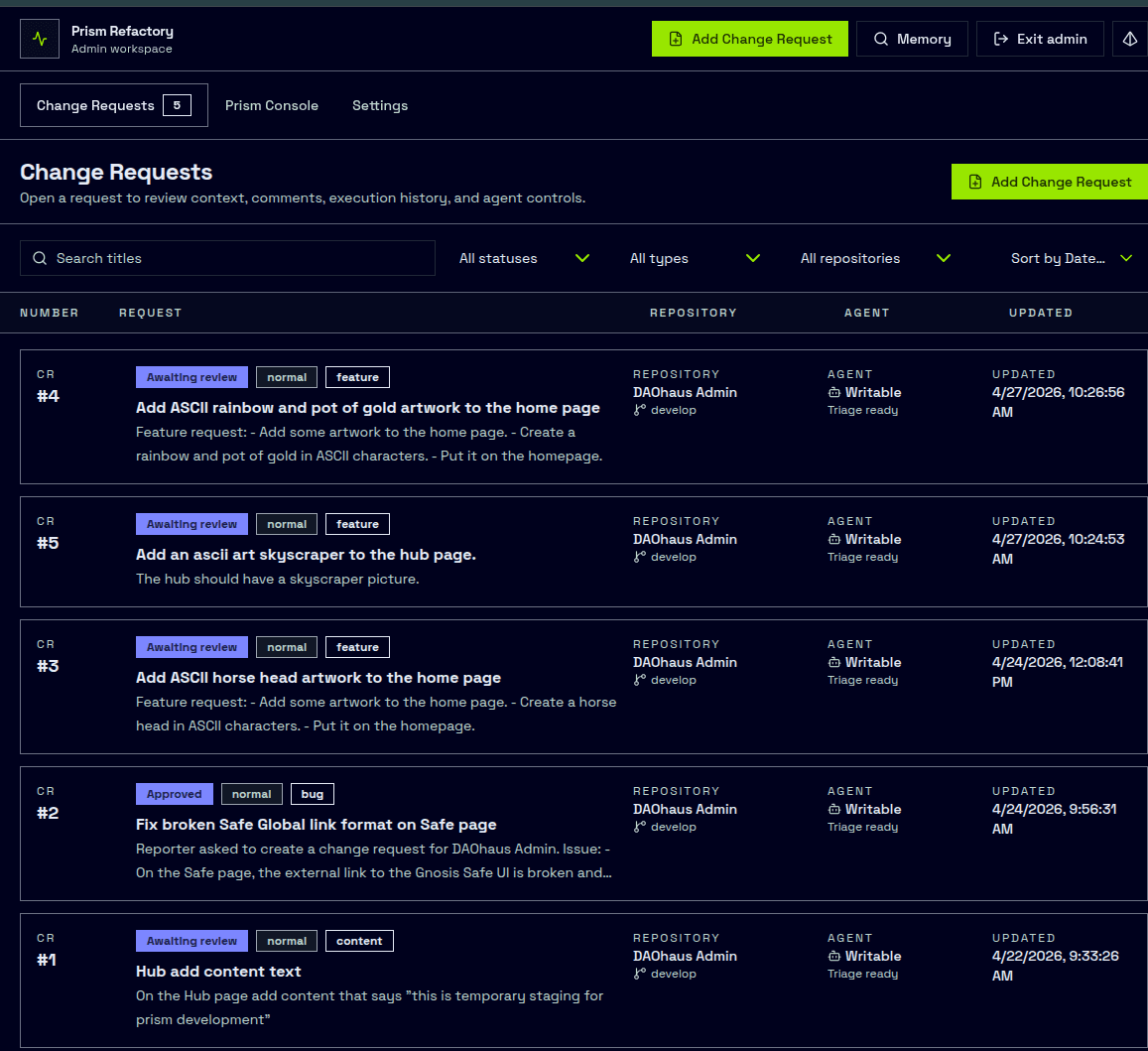
Queue and Coordination
Communities can coordinate multiple requests, triage work, and keep workflow state visible across operators and agents.

Why This Matters
Communities need more than chat history
Shared intelligence requires durable context. If meetings disappear, decisions fragment across threads, and AI only sees isolated prompts, the system never becomes useful at the community level.
Prism Stack is built around the idea that memory, knowledge, and operator control should be treated as infrastructure for communities, not as afterthoughts around a chatbot interface.
Read the Raid Guild articleMemory
Preserve continuity across ongoing community work.
Knowledge
Turn docs, meetings, and archives into usable context.
Operator Workflows
Make review, runtime actions, and coordination visible.
Ownership
Open source infrastructure, not a closed assistant box
Prism Stack is meant to be deployed, operated, and adapted by the communities that use it. That matters when privacy, sovereignty, custom workflow logic, and long-term context continuity are part of the problem.
Fully open source
The stack is inspectable and modifiable. You can understand what it is doing and adapt it to your own workflows.
Self-hostable
Start with Railway, but keep the option to run the system on infrastructure you control as your requirements evolve.
You own the stack
Memory, knowledge, agent runtime, and workflow surfaces are part of your deployment, not just a hosted chatbot account.
Roadmap
Discord-first is the starting point, not the boundary
The current stack is meant to be useful now, but also modular enough to expand into more sources, more runtime choices, and more operator control over time.
More Inputs
Expand beyond Discord with additional source adapters and ingestion surfaces so more community context can flow into the stack.
- •Slack and Telegram adapters
- •broader document and archive inputs
- •more community-native ingestion paths
More Runtime Options
Keep the runtime layer modular so communities can choose how agent execution and model-backed behavior are provided.
- •pluggable harness support
- •external runtime/provider options
- •clearer backend boundaries
More Control
Make configuration, review, and operations easier to manage without losing the system-level visibility that communities need.
- •richer operator workflows
- •policy and config through chat
- •stronger self-hosted deployment paths

The next generation of AI will not be individual.
It will be collaborative.
As AI agents become more common, the challenge is no longer just individual productivity.
The challenge is shared intelligence.
Communities need systems that preserve context across meetings, threads, docs, and turnover. AI is only useful at the group level if shared context remains durable and governable.
How teams create, maintain, and govern context will determine whether AI empowers organizations — or fragments them.
Prism Stack is a practical starting point for collaborative intelligence.
Start with the stack
Prism Stack is meant to be deployed, inspected, adapted, and pushed into real community workflows.
Deploy the Template
Start with the current Railway-based stack and adapt it to your community workflows.
Explore the Architecture
Understand how Discord, memory, knowledge, and runtime services fit together.
Shape the Next Layer
Use the current stack as a base for broader transports, policies, and operator tooling.